
How to Use an Altcoin Scanner: A Practical Research Workflow
A step-by-step method for turning a broad token universe into a focused research list using liquidity, market structure, supply, onchain, and risk filters.
Read the guide →Build a disciplined research queue across AI-assisted ranking, charts, liquidity, wallets, DeFi, RWA tokenization, Solana, Ethereum, new tokens, trends, and platform access.
Static educational portal • Illustrative panels • No live prices • No trade execution • Not investment advice
Showing all illustrative scan profiles.
Start with a broad framework, then open the chain, market, protocol, tokenization, or access page that matches the question you are trying to answer.
Design the universe, gates, evidence groups, outcomes, and review record.
Explore Altcoin Scanner →Use model-assisted ranking without hiding evidence, missing data, or uncertainty.
Explore AI Altcoin Scanner →Read trend, breakout, volatility, liquidity, and benchmark-relative behavior together.
Explore Chart Scanner →Interpret flows with entity labels, confidence, custody context, and counterparty paths.
Explore Wallet Scanner →Separate attention spikes from durable market quality and source-backed catalysts.
Explore Trending Altcoins →Verify identity, contracts, controls, supply, liquidity, team claims, and documentation.
Explore New Altcoins →Connect token behavior to protocol use, liquidity, governance, treasury, and risk.
Explore DeFi Scanner →Research legal claims, reserves, servicing, redemption, custody, and liquidity.
Explore RWA Tokenization →Inspect mints, authorities, extensions, holders, pools, programs, and activity.
Explore Solana Scanner →Resolve ERC-20 contracts, proxies, roles, supply, holders, pools, and layer-2 forms.
Explore Ethereum Scanner →Keep broad research separate from current platform and transfer availability.
Explore Robinhood Altcoins →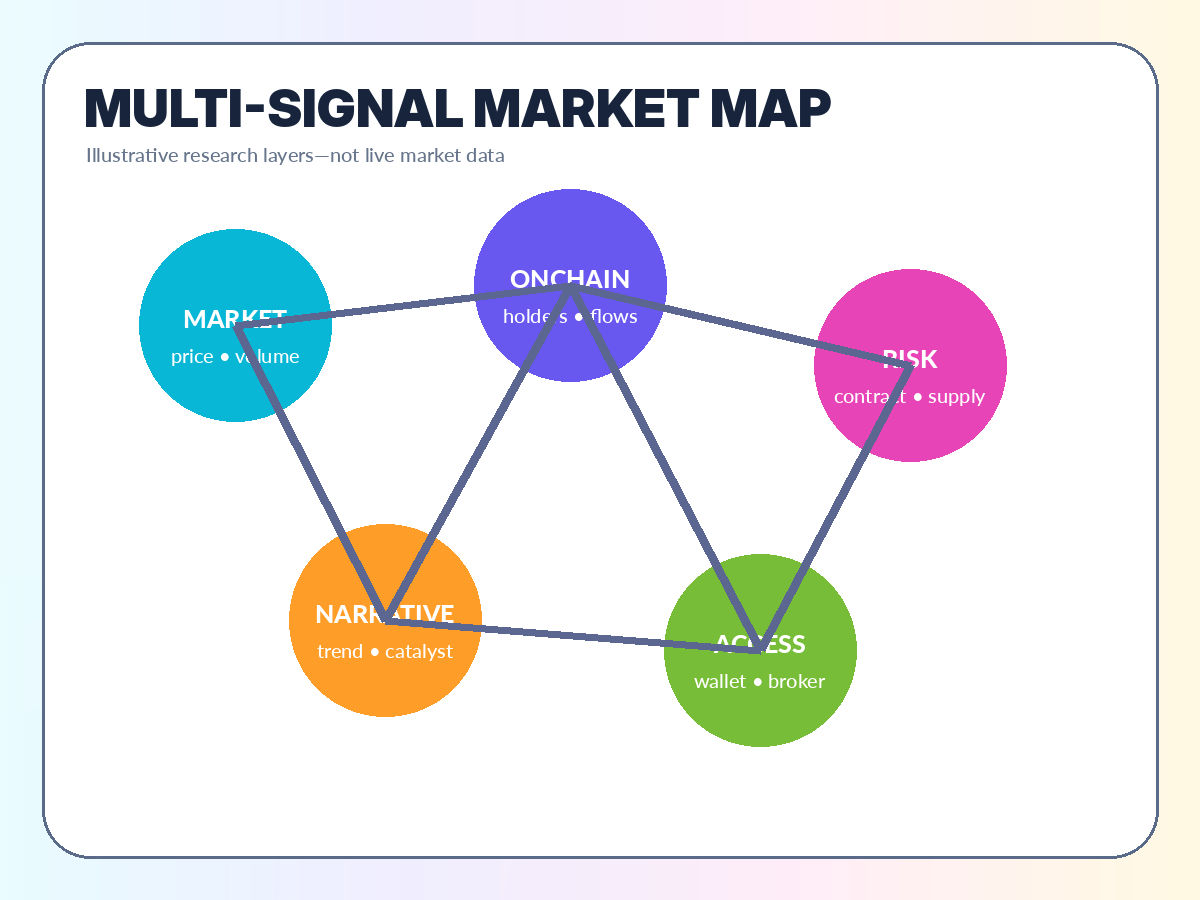
Names and symbols are not reliable database keys. A scanner should anchor every record to the correct chain and contract address or mint, preserve provider mappings, and expose conflicts before combining market, wallet, contract, or access fields.
The values below describe design choices, not current token readings. Each layer has a role, refresh policy, and failure state.
| Layer | Core fields | Decision use | Freshness | Role |
|---|---|---|---|---|
| Identity | Chain + address | Reject on ambiguity | Every refresh | Required |
| Market quality | Spread, depth, impact | Minimum liquidity gate | Minutes to hours | Required |
| Chart structure | Trend + benchmark | Rank, not proof | Chosen timeframe | Context |
| Supply | Circulating + unlocks | Flag dilution | Daily / event | Required |
| Onchain | Holders + activity | Confidence-weighted | Blocks to daily | Context |
| Access | Venue + transfer | Expire stale status | Current check | Operational |
The process should be reproducible by another researcher using the same data snapshot and rules.
Choose chains, categories, history, horizon, target behavior, and non-negotiable exclusions.
Map exact asset identity and remove records with missing history, coverage, or reliable market structure.
Combine independent evidence groups while keeping raw fields, feature contributions, and uncertainty visible.
Assign reject, monitor, or investigate; save the reason, source timestamps, and invalidation conditions.
Ten complete guides cover scanner construction, AI, charts, trending assets, new-token diligence, DeFi, tokenization, Solana, Ethereum, and broker access.
A step-by-step method for turning a broad token universe into a focused research list using liquidity, market structure, supply, onchain, and risk filters.
Read the guide →
Learn what an AI altcoin scanner can rank, where model errors arise, and how to validate signals with transparent features, backtests, confidence checks, and human review.
Read the guide →
A research framework for separating durable attention from short-lived hype using search interest, volume, liquidity, catalysts, persistence, and cross-chain context.
Read the guide →
Research tokenized real-world assets by separating the token, legal claim, issuer, custodian, valuation, reserves, transfer restrictions, liquidity, yield, and oracle dependencies.
Read the guide →
A chart-scanning framework for separating durable breakouts from thin spikes using OHLC data, volume, volatility, relative strength, liquidity, and multi-timeframe confirmation.
Read the guide →
A structured checklist for verifying a new token’s identity, contract controls, supply, holders, liquidity, deployer history, market data, and project claims.
Read the guide →An altcoin scanner is a research system that filters and ranks a defined token universe using documented market, chart, liquidity, supply, onchain, wallet, access, and risk rules.
No. This version is a static educational portal. Its panels and tables are illustrative and do not display live market data, execute trades, or recommend assets.
AI can organize evidence, summarize sources, compare records, and flag anomalies. Identity resolution, source verification, risk gates, and final decisions still require explicit controls and human review.
No reliable scanner can guarantee future performance. A scanner can improve consistency, reduce a large universe, and expose risks, but price outcomes remain uncertain.
Symbols and names can collide across chains. Chain plus contract address or mint provides a stronger identity key for joining market and onchain records.
Passing should move a token into a deeper research queue, not directly into a trade. Review sources, execution conditions, invalidation rules, portfolio fit, and current access before any decision.
Define the universe, protect asset identity, expose weak data, and make every outcome explainable.